

How Is Recycled Gold Processed for New Jewelry?
Introduction
Many clients who visit us at Suren Jewels ask a surprisingly simple question.
If a ring is made from recycled gold does that mean it is somehow second hand.
The concern usually appears when someone is shopping for something meaningful. An engagement ring. A wedding band. A gift marking an important milestone.
People want to know the gold is real. They want to know it will last. They want to know it is not compromised in quality.
The truth is most buyers misunderstand what recycled gold actually means.
Gold is one of the few materials on earth that can be melted down and reused again and again without losing its structure or purity. The gold inside an old necklace from twenty years ago can become part of a brand new engagement ring today. The atoms remain exactly the same.
In our experience at Suren Jewels many clients feel relieved when they learn this. Some even prefer recycled gold because it avoids unnecessary mining and environmental damage.
At the same time people want transparency. They want to understand the process. They want to know what happens between an old broken bracelet and a finished ring sitting inside a jewelry box.
This article explains that entire journey.
We will walk through where recycled gold comes from.
How it is tested and refined.
How it becomes usable metal again.
And how skilled jewelers turn that refined gold into new jewelry.
Along the way we will also explain the real trade offs buyers should understand when choosing recycled gold jewelry.
Because the goal is not marketing language. The goal is clarity.
What Is Recycled Gold?
Recycled gold is gold that has already been mined once and then recovered from existing products instead of extracting new ore from the earth.
Those products can include jewelry that is no longer worn. Industrial components. Old electronics. Coins. Or even dental materials.
The important point is simple. The gold itself is not different from newly mined gold.
Once gold is melted and refined it returns to its pure metallic form. Chemically and physically it becomes identical to gold that has just come from a mine.
That means recycled gold jewelry can achieve the exact same purity levels as newly mined gold.
24K gold remains 24K gold.
18K gold remains 18K gold.
How recycled gold differs from newly mined gold?
The difference is not in the metal itself. The difference is in the origin.
Newly mined gold comes from ore that must be extracted from the earth through mining operations. This process requires heavy equipment chemical processing and significant environmental impact.
Recycled gold avoids that step entirely. The metal already exists above ground.
Old jewelry is melted down.
Industrial scrap is refined.
Electronic components are processed.
After refining the gold becomes pure metal again and can enter the jewelry supply chain.
Why gold can be recycled infinitely?
Gold is a noble metal. That means it does not oxidize easily and does not degrade during melting.
Most materials eventually break down through repeated processing. Plastics weaken. Fibers deteriorate. Some metals become brittle.
Gold does not behave that way.
Even after centuries of use gold can be melted and purified back to nearly perfect purity levels. The gold in a modern ring might once have existed in ancient coins or artifacts centuries ago.
This is why gold recycling plays such an important role in the global gold supply.
In fact a significant portion of the gold used in modern jewelry already comes from recycled sources.
Where Does Recycled Gold Come From?
Many people imagine recycled gold coming only from old jewelry. That is certainly one source. But the supply actually comes from several different areas.
Old and broken jewelry
This is the largest and most common source.
Jewelry often becomes outdated. Chains break. Rings no longer fit. Earrings lose their pair.
In our workshop at Suren Jewels we often see customers bring in pieces inherited from family members. Some pieces carry strong emotional value. Others simply sit in drawers for years without being worn.
When jewelry no longer serves its purpose the gold can be recovered and refined.
The gemstones may be reused. The metal is melted down.
Coins and bullion
Some investors sell gold coins or bars when market prices rise. These pieces often enter the refining system where they are melted and converted into new forms.
Because bullion typically contains high purity gold the refining process is relatively straightforward.
Electronic waste
This source surprises many people.
Modern electronics contain small amounts of gold because the metal conducts electricity extremely well and resists corrosion.
Gold appears in circuit boards connectors and microchips.
Individually the quantities are tiny. When processed at scale however electronic recycling can recover significant amounts of gold.
Industrial scrap and manufacturing waste
Jewelry manufacturing itself generates gold waste.
Tiny filings from polishing. Small leftover pieces from casting. Production scraps.
Responsible manufacturers collect this material and send it back to refineries so it can be reused.
At Suren Jewels we ensure that production waste from our workshop is carefully recovered and returned to the refining process rather than discarded.
Dental and medical gold
Dentistry has used gold alloys for decades because gold is highly biocompatible. Old dental crowns or medical components may contain gold that can be recovered and refined.
This source represents a smaller portion of recycled gold supply but it still contributes to the overall system.
Why Gold Is Perfect for Recycling?
Gold possesses several unique properties that make it ideal for recycling.
Chemical properties of gold
Gold sits in a group of metals known as noble metals. These metals resist chemical reactions that degrade most other materials.
This stability allows gold to survive repeated heating and refining processes without losing structural integrity.
Resistance to corrosion and oxidation
Iron rusts. Silver tarnishes.
Gold remains stable even after decades of exposure to air and moisture.
This resistance helps preserve the metal even when it comes from very old jewelry pieces.
High melting point and malleability
Gold melts at approximately 1064 degrees Celsius.
That temperature is high enough to separate many impurities but low enough for efficient refining processes.
Gold is also extremely malleable. A small amount of gold can be shaped into thin sheets or wires without cracking.
These characteristics make gold easy to work with during jewelry manufacturing.
Ability to maintain purity after repeated recycling
Perhaps the most important factor is gold's ability to return to extremely high purity levels after refining.
Refining techniques can produce gold with purity levels above 99.9 percent.
At that point the metal becomes chemically identical to newly mined gold.
This is why recycled gold jewelry can meet the same quality standards as any other fine jewelry.
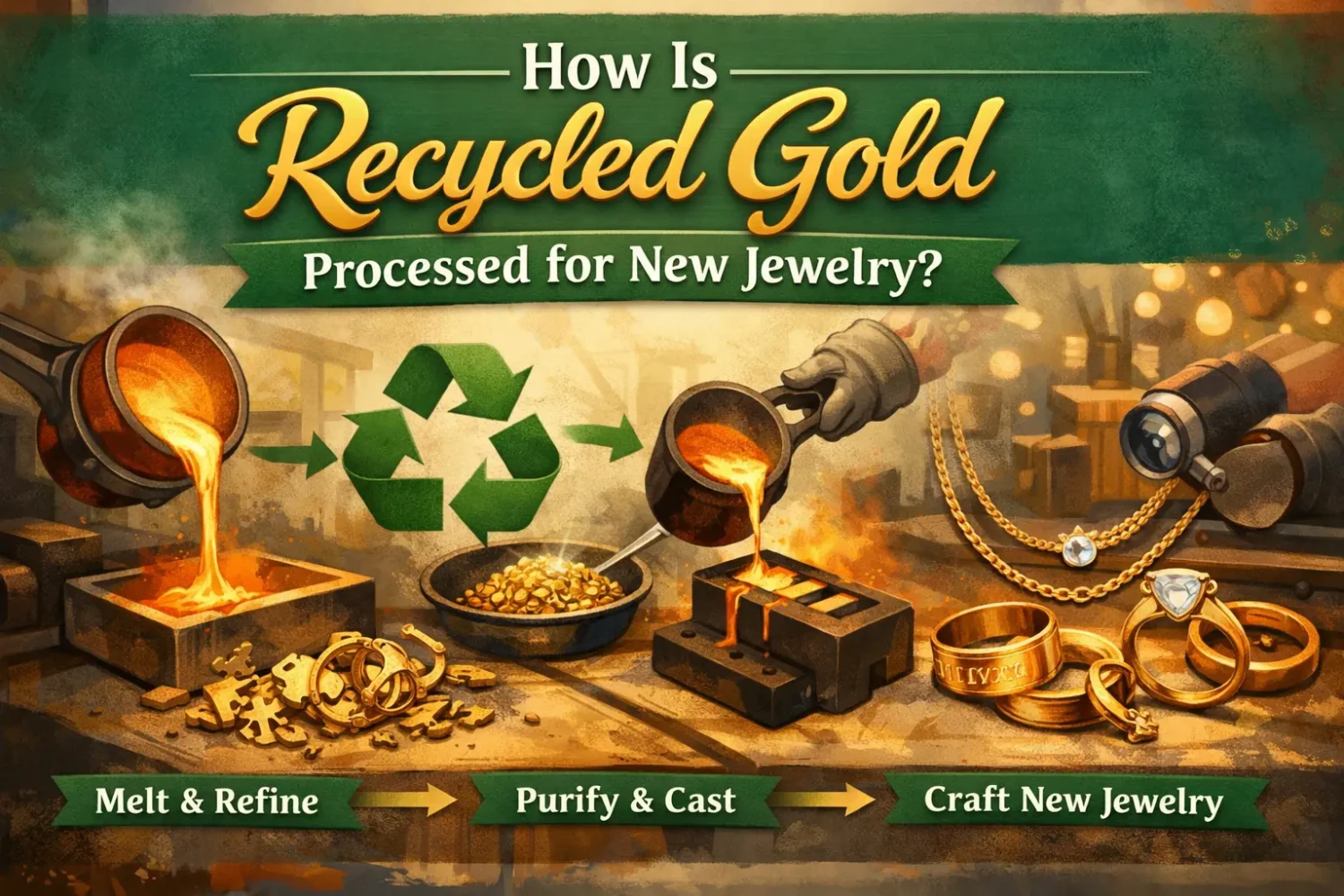
The Complete Process of Recycling Gold for Jewelry
Understanding this process helps buyers appreciate the craftsmanship behind recycled gold jewelry.
The journey from scrap gold to finished jewelry involves multiple stages.
Collection of Scrap Gold
The process begins with collecting gold materials from various sources.
Consumer jewelry recycling forms a major portion of the supply. Jewelers buy unwanted pieces from customers. Pawn shops and gold buyers gather scrap jewelry. These pieces are sent to specialized refineries.
Industrial gold recovery follows a different path. Electronic recyclers collect old devices and extract components containing precious metals.
At Suren Jewels we sometimes assist clients who wish to redesign inherited pieces. In some cases the original gold can be reused directly. In other cases the metal must go through refining first.
Sorting and Classification
Before refining begins the collected gold must be sorted.
Gold items come in different karat levels.
10K gold contains roughly forty percent pure gold.
14K contains about fifty eight percent.
18K contains seventy five percent.
22K and 24K contain even higher concentrations.
Sorting helps refiners manage the purification process more efficiently.
Mixed metals and contaminants are also removed at this stage.
Gold Purity Testing
Refiners must know exactly how much gold is present in the material.
Several testing methods exist.
Acid testing remains one of the oldest methods. A small scratch is made on a testing stone and treated with acid solutions that react differently depending on the gold content.
Electronic conductivity testing measures how electricity flows through the metal. Different alloys produce distinct readings.
X ray fluorescence testing uses advanced machines to analyze the elemental composition of the metal without damaging it.
Fire assay testing remains the most precise technique. A sample is melted under controlled conditions and analyzed to determine exact gold content.
Removal of Non Gold Components
Jewelry often contains parts that cannot enter the refining furnace.
Gemstones must be removed.
Clasps and springs often contain steel components.
Solder materials may contain other metals.
These elements are separated before melting begins.
In many cases gemstones are carefully preserved and reused in new designs.
Melting Scrap Gold
Once prepared the gold scrap enters high temperature furnaces.
The metal melts into liquid form at approximately 1064 degrees Celsius.
Flux materials such as borax are added to help separate impurities from the molten gold.
Impurities rise to the surface as slag and are removed.
The molten gold is then poured into molds to form rough bars.
Refining and Purification
The rough bars still contain alloy metals and trace contaminants.
Refining methods remove these elements and isolate pure gold.
The Miller process introduces chlorine gas into molten gold. Base metals react with chlorine and separate from the gold.
The Wohlwill process uses an electrolytic method. Gold dissolves into a chemical solution and then redeposits onto electrodes as extremely pure metal.
Aqua regia refining uses powerful acids to dissolve gold and then precipitate it back into solid form.
These techniques can produce gold with purity levels above 99.9 percent.
Creating Gold Grain or Ingots
After purification the gold is cast into forms that jewelers can use.
Large bars may be produced for storage and transport.
Smaller grain pellets are created for jewelry manufacturing. These small beads melt quickly during casting processes.
At this stage the gold is essentially raw material ready for jewelry production.
Alloying Gold for Jewelry
Pure gold is beautiful but very soft.
A ring made entirely from pure gold would scratch easily and lose shape over time.
For this reason jewelers mix gold with other metals.
Silver and copper are common additions. Zinc nickel and platinum may also be used depending on the desired color and strength.
These combinations create familiar jewelry alloys such as 18K gold and 14K gold.
Each alloy balances purity with durability.
Jewelry Casting and Manufacturing
Once alloyed the gold enters the jewelry manufacturing process.
The lost wax casting method remains one of the most widely used techniques.
A wax model of the jewelry piece is created. This model is surrounded by a special casting material. When heated the wax melts away leaving a mold.
Molten gold is poured into the mold forming the basic shape of the jewelry.
The piece is then cleaned polished and refined by skilled jewelers.
Gemstones are set carefully. Surfaces are polished to achieve the final finish.
At Suren Jewels our craftsmen spend many hours refining each piece before it reaches a customer.
Small details matter. The balance of the ring. The comfort of the band. The security of the gemstone setting.
Those finishing touches transform refined gold into something meaningful.
Quality Control and Hallmarking
Every reputable jewelry piece must meet strict purity standards.
Testing laboratories verify the gold content through advanced analytical methods.
Hallmarks are then stamped on the jewelry indicating its karat level.
18K
14K
22K
These markings provide assurance that the metal meets official standards.
For buyers this hallmark acts as a guarantee of authenticity.
Environmental Benefits of Recycled Gold
Gold mining carries significant environmental costs.
Large areas of land must be excavated to extract gold ore. Chemical processes are required to separate gold from surrounding rock.
Recycling reduces the need for new mining operations.
Studies suggest recycled gold can use up to ninety five percent less energy than newly mined gold production.
Less mining means less habitat destruction. Lower water consumption. Reduced pollution.
Many clients at Suren Jewels appreciate knowing their jewelry contributes less environmental impact.
Ethical Benefits of Using Recycled Gold
Gold mining in certain regions has historically involved difficult labor conditions and political conflict.
Recycled gold helps reduce demand for newly mined sources.
Responsible sourcing programs and recycling initiatives contribute to a more transparent supply chain.
Consumers increasingly value jewelry that aligns with ethical principles.
Recycled Gold vs Newly Mined Gold
When properly refined recycled gold is identical to newly mined gold.
Quality and durability remain the same.
The primary differences relate to sourcing and environmental impact.
Some buyers assume recycled gold should cost less. That is not always true.
Gold prices depend largely on global market rates rather than mining origin.
How Jewelry Brands Use Recycled Gold Today?
Many modern jewelry brands incorporate recycled gold into their collections.
Luxury brands have begun emphasizing sustainable materials.
Clients frequently ask us about sourcing transparency. They want to know where the metal comes from.
At Suren Jewels we believe responsible sourcing should become standard practice across the industry.
Future of Recycled Gold in Jewelry
Recycling technologies continue to improve.
Urban mining from electronic waste is expanding.
Advanced refining techniques allow more efficient recovery of gold from complex materials.
Blockchain tracking systems are beginning to appear in precious metal supply chains.
These technologies aim to improve traceability and transparency.
Conclusion
Gold has always carried symbolic value. It represents commitment celebration and lasting beauty.
Yet behind every finished ring lies a complex journey.
Recycled gold proves that valuable materials do not need to be extracted endlessly from the earth. Existing gold can be refined and reused without losing quality.
From scrap jewelry to purified metal to finished craftsmanship the transformation requires both advanced technology and skilled artisans.
Buyers who understand this process gain greater confidence when choosing recycled gold jewelry.
At Suren Jewels we see recycled gold not as a compromise but as a continuation of gold's long history.
Gold has always been reused melted and reshaped across generations.
That tradition continues today.
Frequently Asked Questions
Q1. Is recycled gold real gold?
Ans1. Yes. Once refined recycled gold becomes chemically identical to newly mined gold.
Q2. Does recycled gold lose its quality?
Ans2. No. Gold retains its purity after refining and recycling.
Q3. How many times can gold be recycled?
Ans3. Gold can be recycled indefinitely without degradation.
Q4. Is recycled gold cheaper than mined gold?
Ans4. Not necessarily. Gold prices are determined by global market rates rather than origin.
Q5. Can recycled gold be used for engagement rings?
Ans5. Yes. Many engagement rings today use recycled gold with identical quality.
Q6. Is recycled gold environmentally friendly?
Ans6. Yes. Recycling significantly reduces the environmental impact associated with mining.
Q7. Is recycled gold as good as new gold?
Ans7. Yes. After refining the metal becomes indistinguishable from newly mined gold.
Q8. How much gold is in electronic waste?
Ans8. The amount varies. Some estimates suggest one ton of electronic waste may contain several hundred grams of recoverable gold.
Q9. What is the process of recycled gold?
Ans9. The process includes collection sorting testing melting refining alloying and jewelry manufacturing.
Q10. How much do jewellers pay for scrap gold?
Ans10. Prices depend on gold purity weight and current market rates.
Understanding the process helps buyers appreciate the real value behind recycled gold jewelry.
Recent Posts

Gold Chain Manufacturers You Can Trust Suren Jewels

9K Gold Jewelry Manufacturer for US Brands

How Is Recycled Gold Processed for New Jewelry?

why do wedding rings go on left hand
Related products

14K Yellow Gold pave Diamonds Band Ring Jewelry Bands Rings Manufacturer

925 Silver Natural Silver RH Band Ring Jewelry Bands Rings Manufacturer

14K Yellow Gold Malachite Engraved Ring Jewelry Manufacturer

14K Yellow Gold Men's Ring Jewelry Manufacturer
925 Silver Gold Plated Men's Ring Jewelry Manufacturer


Private Lable 14K Yellow Gold Plated Pave Diamond & Rose Cut Ddiamond Ring Jewelry

Wholesale 925 Silver Yellow Gold Moissanite Round Ring Jewelry
Wholesale 14K Gold Moissanite Diamond Round Ring Jewelry

14K Gold Turkish Turquoise 5 Row Band Ring – Gemstone Link Cigar Band

Wholesale 14K Yellow Gold Moissanite Turquoise Enamel Band Ring

14K yellow Gold Yellow Sapphire Ring Jewelry Supplier

14K Yellow Gold Diamond Black CZ Band Connector Ring

14K Yellow Gold Malachite Red White CZ Ring Custom Jewelry

14k Rose Gold Malachite And Lapiz Lazuli White CZ Ring Manufacturer

Private Label 14K Yellow Gold Moonstone CZ & Blue CZ Ring

Wholesale 9K Rose Gold Cubic Zircon Connected Ring Jewelry

Wholesale 925 Silver Yellow Gold Plated Cubic Zircon Connected Ring Jewelry
Private Label 925 Sterling Silver Yellow Gold Plated Moonstone CZ & Blue CZ Ring
Contact Us For Custom Jewelry
Please get in touch with us and share your ideas if you have personalized jewelry or are searching for a private label jewelry manufacturer. In accordance with your suggestions, we will make and present genuine jewelry.
Drop Us a Line
Scan QR Code
for immediate contact



Contacts
-
Address
FF-206, Kishanpole Bazar, Jaipur, Rajasthan
-
Phone / WhatsApp
+91 9216779317
-
Email
My Account
Subscribe to our newsletter for regular updates about Offers, Coupons & more
-
Address
FF-206, Kishanpole Bazar, Jaipur, Rajasthan
-
Phone
+91 9216779317
-
Email
-
For Order Related Query
Please get in touch with the above mentioned number on whatsapp only
-
Opening Hours
Monday to Sunday | 10:00 AM to 7:00 PM